

Rent reviews in a commercial lease are one of the most important — and often misunderstood — aspects of occupying business premises. If you’re taking on a commercial property, whether a shop, office, or industrial unit, your lease will almost certainly include a rent review clause. Understanding how these reviews work, what the common clauses mean, and how to negotiate effectively can protect your business from unexpected cost increases down the line.
This guide walks you through everything you need to know about commercial lease rent reviews in plain English, so you can approach them with confidence.
What is a rent review in a commercial lease?
A rent review is a formal reassessment of the rent you pay under your commercial lease. Rather than fixing the rent for the entire lease term, most landlords include a review mechanism that allows the rent to be adjusted at set intervals — typically every three to five years.
The purpose is straightforward: over a long lease, market conditions change. A landlord who agreed to a rent in 2018 may find that figure is well below current market rates by 2023. A rent review clause gives them the ability to reset the rent to a figure that reflects the current value of the property.
That said, rent reviews do not always mean your rent will go up. The outcome depends on the type of review clause in your lease, the state of the local market, and — crucially — how well you negotiate. If you’re unsure what your lease says, having your lease professionally reviewed before any review process begins can make a significant difference. Our solicitors’ commercial lease drafting and review service can help you understand exactly what you’ve agreed to.
Common types of commercial lease rent review clauses
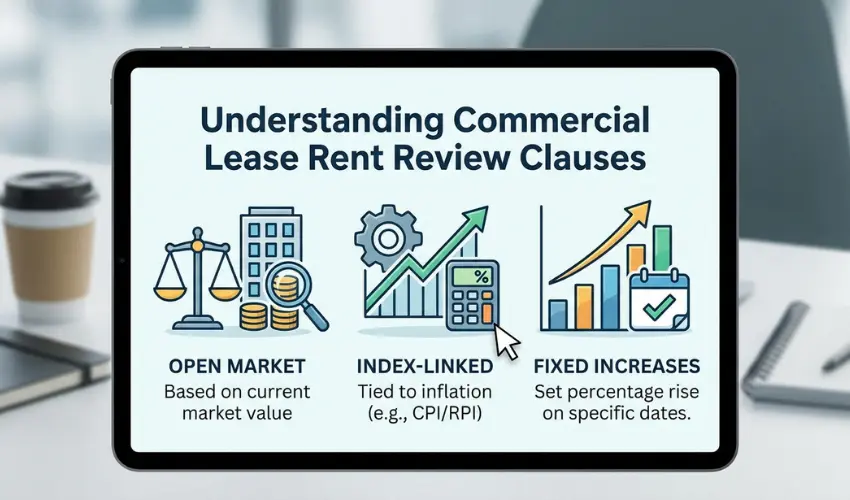
Your commercial lease rent review clause will specify how the new rent is calculated. There are three main methods used in England and Wales:
Open market rent review
This is the most common approach. The rent is reset to reflect what a new tenant would reasonably pay for the property in the open market at the time of the review. Valuers acting for both parties will assess comparable properties and negotiate a figure.
Most open market rent review clauses include an “upwards-only” provision, meaning the rent can increase but never fall below the current level — even if the market has dropped. The UK government has proposed banning upwards-only clauses for new leases through the English Devolution and Community Empowerment Bill, though this legislation is still working its way through Parliament.
Index-linked rent review
Here, the rent increases in line with an inflation index, typically the Retail Prices Index (RPI) or the Consumer Prices Index (CPI). This method provides more predictability for both parties, but you should read the clause carefully. A common drafting error occurs when a lease fails to reset the base RPI figure at each subsequent review — this can result in compounding increases that far exceed what was intended.
Stepped or fixed rent increases
Some leases simply agree upfront on set rent increases at specific dates — for example, a £2,000 increase at year three and another at year six. These are easier to plan around, though they may not reflect actual market conditions by the time they take effect. Stepped rents work best for shorter leases of two to three years.
Turnover rent
Less common but worth knowing about, a turnover rent links all or part of your rent to your business’s annual turnover. Landlords typically offer a lower base rent in exchange for a share of revenue. If you operate from multiple sites, ensure the clause clearly identifies which site’s turnover is being calculated.
How the rent review process works
Regardless of the review type, the process tends to follow a similar sequence:
- The landlord (or in some cases the tenant) serves a trigger notice, setting out the proposed new rent and the review date. This is typically required at least three months in advance.
- You have a fixed window to respond with a counter-notice if you disagree with the proposed figure.
- Both parties — usually through their surveyors or solicitors — negotiate to reach an agreed rent.
- If no agreement is reached, the lease will specify a dispute resolution route, most commonly appointment of an independent RICS-registered arbitrator or expert.
- Once agreed, the new rent is recorded in a formal memorandum attached to the lease.
An important practical point: if the rent is not agreed by the review date, your existing rent continues to be payable. However, once agreement is reached, the increased rent is typically backdated to the review date — and interest may be added on the underpayment. This is a strong reason not to drag out negotiations.
How market rent reviews operate in practice
For open market rent reviews specifically, the valuation is based on a hypothetical new lease being granted on similar terms to your existing one. Both parties instruct valuers who gather comparable evidence — recent lettings of similar properties in the area, adjusted for size, condition, location, and lease terms.
Matters to be disregarded in the valuation are usually set out in the lease and often include:
- Any goodwill you’ve built up in the property
- Improvements you’ve carried out at your own cost
- The fact that you’re already in occupation
These disregards are there to protect you as a tenant — for instance, if you’ve spent £30,000 fitting out the premises to a high standard, the valuation should not reflect that added value as if the landlord were responsible for it.
Not sure how much a bridging loan will really cost?
Monthly rates are only part of the picture. Fees, loan structure, and your exit timeline all affect the total cost of bridging finance. Speak to a specialist solicitor
What happens if you cannot agree on the new rent?
If negotiations break down, your lease will contain a mechanism for resolving the dispute. Most modern leases allow either party to apply to the President of the Royal Institution of Chartered Surveyors (RICS) to appoint an independent expert or arbitrator. This is marked as a nofollow link for reference.
The distinction matters:
- An arbitrator hears submissions from both sides and makes a binding decision based on the arguments presented.
- An independent expert uses their own knowledge and judgement to determine the rent, typically without hearing formal arguments.
Third-party determination can add cost — often around £1,000 or more per party — and should be treated as a last resort. Approaching the review with professional advice from the outset is almost always more cost-effective.
How to negotiate a rent review in a commercial lease
Negotiating a rent review is not just about pushing back on a number — it’s about preparing properly, knowing your position, and engaging constructively. Here are the most effective strategies:
Understand your lease clause before anything else
Read your commercial lease rent review clause carefully. Know when the review is due, what method is used, what notice periods apply, and whether your rent is upwards-only. Missing a response deadline can mean losing your right to challenge the proposed increase altogether.
Research the local market
Gather evidence of what comparable properties in your area are currently renting for — similar size, location, specification, and lease terms. This gives you an objective basis for negotiation and strengthens any counter-proposal you make.
Appoint a chartered surveyor
A RICS-registered commercial surveyor experienced in rent reviews is one of the most valuable investments you can make. They will carry out a professional valuation, identify comparable evidence, and negotiate directly with the landlord’s valuer on your behalf. Their fee will typically be far outweighed by the rent savings they secure.
Highlight tenant-funded improvements
If you’ve made improvements to the property at your own expense, document them thoroughly. These should be disregarded in the valuation, but landlords sometimes attempt to factor them in. Having clear records of the works and costs means you can robustly challenge any inflated figures.
Use market conditions to your advantage
If the local property market is slow, or the landlord has other vacant units, your negotiating position is stronger than it might appear. A good tenant who pays reliably is worth retaining. If you’re considering any lease variations or extensions as part of the negotiation, these can sometimes be offered in exchange for a more favourable rent position.
Never accept the first offer without analysis
The initial rent proposed by a landlord is rarely the final figure. Always respond with a counter-notice and instruct your advisers to assess the proposal against market evidence before agreeing to anything.
Record everything in writing
Once a new rent is agreed, ensure it is formally documented in a memorandum signed by both parties and attached to the original lease. Verbal agreements are not sufficient and can lead to disputes later.
Key points to watch out for in your rent review clause
Not all rent review clauses are drafted equally. When reviewing your lease, pay close attention to:
- Upwards-only restrictions — are you prevented from benefiting if the market falls?
- Index-linked base reset issues — does the RPI/CPI base figure reset at each review or accumulate from the start?
- Trigger notice requirements — who must serve notice, and by when?
- Disregard provisions — are improvements and goodwill properly excluded from the valuation?
- Break clause links — is there a break clause tied to the review date, giving you an exit if the increase is unacceptable?
- SDLT implications — a significant rent increase may trigger a Stamp Duty Land Tax liability, which should be factored into your planning.
If you’re negotiating a new lease and want to ensure the rent review clause is drafted in your favour from the outset, our team can assist. You can find out more about our approach to commercial lease terms negotiation or explore what a commercial lease involves before you sign.
Summary
Rent reviews in a commercial lease are a significant financial milestone, but they don’t have to be a source of stress. With the right preparation, a clear understanding of your lease clause, solid market evidence, and professional advice, you can approach any negotiate rent review with confidence.
Whether you’re facing your first review or renegotiating an existing lease, the key is not to treat it as a formality. If you’d like a fixed-fee quote for legal support, you can request a solicitor quote here.
Need advice on a bridging loan before you commit?
Bridging loan interest rates vary based on loan-to-value, property type, and your exit strategy. The headline rate is only part of the picture — fees, structure, and legal timelines all affect the total cost. Our specialist solicitors ensure your bridging finance is structured correctly, the legal process runs smoothly, and your transaction completes on time.