

Service charges in commercial leases are one of the most significant — and most commonly misunderstood — costs a business tenant will face. They sit on top of your base rent, they can rise year on year, and the scope of what a landlord is permitted to recover through them varies considerably depending on how your lease is drafted.
In the UK commercial property market, these charges go by several names. You may see them referred to as CAM charges, service charges, or operating expense recoveries. While the terminology differs, the underlying concept is the same: the landlord incurs costs maintaining and operating the building, and a portion of those costs is passed through to tenants.
This guide explains what CAM charges and service charges cover, how they are calculated, what your lease should say about them, and how to protect your position during lease negotiation before you commit to a long-term tenancy.
What are service charges in commercial leases?
A service charge is an additional payment made by a commercial tenant to reimburse the landlord for costs associated with maintaining and operating the parts of the building that all occupiers share. These shared areas — typically referred to as common areas — include entrances and lobbies, lifts, stairwells, car parks, external landscaping, and plant rooms housing mechanical or electrical systems.
Service charges are distinct from your base rent. They are a separate, variable liability that reflects actual expenditure on the building rather than a fixed contractual sum. The total amount you pay can therefore change year to year, depending on what maintenance work is carried out, how efficiently the building is managed, and what the lease says about how costs are allocated.
In multi-let commercial buildings — such as office developments, retail centres, and business parks — service charges are the primary mechanism through which a landlord recovers the cost of keeping the whole building functional. Without them, the landlord would either absorb those costs entirely or allow shared spaces to deteriorate.
What do CAM charges and service charges cover?
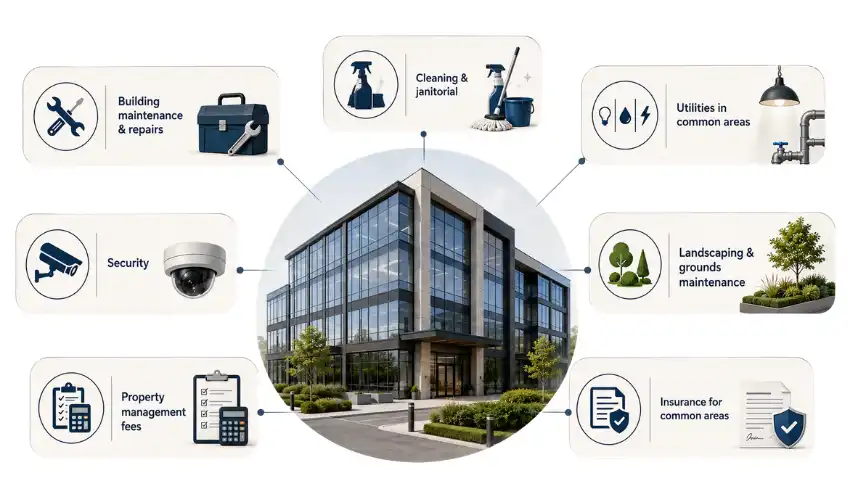
The precise scope of CAM charges depends on the terms of your individual lease, but there are categories of expenditure that appear in most commercial service charge schedules. Understanding each of them is essential before you sign.
Building maintenance and repairs
This typically covers the cost of repairing and maintaining the physical structure of the common areas — including lifts, HVAC systems, car park surfaces, drainage, and shared mechanical or electrical infrastructure. Routine maintenance contracts, emergency call-outs, and planned replacement of components that fall short of capital expenditure are all ordinarily included.
Cleaning and janitorial services
The cost of cleaning shared corridors, toilets, reception areas, and external hard surfaces forms a standard element of most service charge schedules. In office buildings, this can represent a material proportion of total annual expenditure. In retail or industrial settings, it varies depending on the specification of the cleaning contract.
Utilities in common areas
Electricity for lighting and power in shared spaces, water for landscaping and building services, and heating or cooling for common areas are all recoverable through the service charge. These costs fluctuate with energy prices and usage, which is one reason service charges in commercial leases can increase significantly in years when energy costs rise sharply.
Security
Staffed security at building entrances, CCTV systems, access control infrastructure, and car park management may all be included. In city centre office buildings, security can be one of the largest single items in the service charge budget.
Landscaping and grounds maintenance
External areas around the building — planted borders, grass, trees, and external paving — are typically maintained through the service charge. Seasonal contractors, irrigation systems, and replanting after weather damage are all common recoverable items.
Property management fees
The landlord’s property manager charges a fee for administering the service charge, overseeing contractors, preparing annual budgets, and managing accounts. This fee is typically expressed as a percentage of total service charge expenditure and is recoverable from tenants. It is a legitimate cost, but one that tenants can and should scrutinise during lease negotiation.
Insurance for common areas
Building insurance — covering the structure, common areas, and the landlord’s liability in shared spaces — is routinely recovered through the service charge. Note that this is separate from your own occupier’s liability insurance, which remains your responsibility as tenant.
How are CAM charges calculated?
The most widely used method for calculating each tenant’s contribution to CAM charges is the pro rata share approach. This means your portion of the total service charge is calculated by reference to the amount of floor space you occupy relative to the total lettable floor area of the building.
The formula looks like this:
Tenant’s CAM contribution = (Tenant’s floor area ÷ Total lettable floor area) × Total service charge expenditure
As a worked example: if the total annual service charge expenditure for a building is £300,000 and your unit represents 10% of the total lettable area, your annual service charge liability is £30,000 — or £2,500 per month. If your share is 5%, you pay £15,000 per year.
In practice, landlords estimate the likely service charge expenditure at the beginning of each year and bill tenants monthly based on that estimate. At the end of the year, they reconcile the estimate against actual costs. If actual spending exceeded the estimate, tenants pay a balancing charge. If it fell short, tenants receive a credit or refund.
This annual reconciliation process is an important moment for tenants. It is the point at which errors, over-recoveries, or disputed items can be identified and challenged — provided your lease gives you the right to do so. Ensuring that your lease includes clear audit rights is one of the most valuable protections you can negotiate before signing.
Worried about CAM charges or unexpected service charge costs?
Service charges in commercial leases can rise quickly if the drafting is too wide or the landlord’s recovery rights are unclear. Speak to a commercial lease solicitor before signing or challenging a disputed demand.
How lease type affects your service charge liability
The structure of your lease directly determines your exposure to service charges in commercial leases. Three main lease types are used in the UK commercial property market:
- Full repairing and insuring (FRI) lease. This is the most common commercial lease structure in the UK. Under an FRI lease, the tenant is responsible for all repairs and outgoings relating to their own unit, and contributes to the service charge for common area costs. For landlords, this structure provides maximum cost recovery.
- Internal repairing and insuring (IRI) lease. A less onerous arrangement for tenants, typically used in multi-let buildings. The tenant repairs and insures only the interior of their unit, with external and structural repairs covered by the landlord through the service charge.
- Gross or inclusive lease. A smaller number of commercial leases include all outgoings — including service charges — within a single fixed rent. This gives tenants cost certainty but often at a premium rent level that already factors in the landlord’s estimated outgoings.
Understanding which structure you are entering before you sign is essential. If you are unsure, our guide to what a commercial lease is and how it works in the UK provides a clear overview of the key terms and obligations that apply to different lease types.
What should be excluded from service charges?
Not every cost a landlord incurs can legitimately be passed through the service charge. Understanding what should be excluded is just as important as knowing what is included.
Capital expenditure — such as the replacement of a roof, the installation of a new lift, or major structural works that add value to the building rather than simply maintain it — should ordinarily be excluded from the service charge or, at a minimum, amortised over several years rather than charged in full in a single year. A landlord who attempts to recover the full cost of a major capital project through the service charge in one financial year may be acting outside the scope of what the lease permits.
Other items that should typically be excluded include:
- Costs relating to vacant units — the landlord should absorb the service charge share for any empty space they own
- Landlord’s legal costs arising from disputes with other tenants
- Marketing or promotional costs for the building or development
- Improvements that go beyond maintaining the existing standard of the building
These exclusions should be explicitly defined in your lease. Vague drafting in the service charge provisions is one of the most common sources of landlord-tenant disputes in commercial property — and one of the strongest reasons to have your lease reviewed by a specialist solicitor before it is signed.
Protecting yourself during lease negotiation
Service charge provisions are negotiable. Many tenants accept standard landlord’s lease drafting without challenge, assuming the terms are fixed. In practice, there is often significant scope to improve your position during lease negotiation, particularly on larger or longer-term lettings.
The following protections are worth pursuing:
- A service charge cap. Negotiating a cap on the annual increase in controllable service charge costs — typically expressed as a percentage of the previous year’s expenditure (commonly 5%) — protects against unpredictable spikes. Caps are more commonly agreed on office and retail lettings than on industrial estates.
- Audit rights. Your lease should give you the right to inspect the landlord’s service charge accounts and supporting invoices. Without this, you have no practical means of verifying that the amounts billed to you are accurate.
- A defined exclusions list. Ensure the lease contains explicit language setting out what cannot be included in the service charge — capital expenditure, vacant unit costs, and landlord-only legal costs in particular.
- A base year or expense stop. In some lease structures, a base year is established against which future increases are measured. This means you only pay for service charge costs that exceed the base year level, giving you a degree of cost certainty in early years.
- Sinking fund provisions. A well-drafted lease may include a sinking fund or reserve fund into which contributions are made over time to cover anticipated large expenditure items. This smooths out the impact of major works and prevents large one-off demands.
Whether you are taking a new lease, renewing an existing one, or entering a subletting arrangement, having a specialist review the service charge provisions before you commit is time and cost well spent. Our lease terms negotiation service is specifically designed to help tenants and landlords achieve clear, balanced drafting on all financial provisions, including service charges.
Common disputes over service charges and how to resolve them
Disputes between landlords and tenants over CAM charges and service charges are amongst the most frequent sources of commercial property litigation in England and Wales. Most arise from one of three causes: unexpectedly large year-end balancing demands, costs included in the schedule that tenants believe fall outside the lease definition, or a failure by the landlord to provide timely and transparent accounts.
The first step in resolving a service charge dispute is to review the lease carefully against the charges being levied. If there is a genuine discrepancy between what the lease permits and what is being billed, this should be raised formally with the landlord in writing, with reference to the specific lease provisions.
If the dispute cannot be resolved through correspondence, the options available depend on the lease terms and the amounts involved. Mediation is often a cost-effective route for smaller disputes. For larger or more complex matters, formal legal proceedings or expert determination may be necessary.
Whatever route is taken, acting quickly matters. Service charge demands often carry deadlines, and failing to respond formally to an inflated demand can in some circumstances be treated as acceptance. Our commercial lease dispute resolution service advises tenants and landlords on the full range of options available when a service charge dispute arises, from initial correspondence through to formal proceedings.
Why getting service charge provisions right from the start matters
Service charges can represent a very significant additional cost on top of your headline rent. On a commercial property occupied for five, ten, or fifteen years, even a modest annual service charge can amount to a six-figure liability over the life of the lease. Poorly drafted provisions, an absence of audit rights, or a failure to exclude capital expenditure can leave tenants paying far more than they bargained for. Understanding service charges in commercial leases before you sign — not after a disputed demand arrives — is the most effective protection available to any business tenant. That means reading the service charge schedule carefully, understanding the calculation methodology, and knowing what questions to ask during lease negotiation. If you are considering taking a new commercial tenancy and want a solicitor to review the service charge provisions before you sign, our commercial lease drafting and review service provides a thorough analysis of all financial obligations in the lease, including service charges, rent review clauses, and repair covenants. The Royal Institution of Chartered Surveyors publishes a Service Charges in Commercial Property Code of Practice that sets out best practice standards for landlords and tenants on service charge management and transparency.Need clarity on service charges in your commercial lease?
CAM charges and service charges can add significant costs on top of your rent, especially if the lease allows broad cost recovery, unclear exclusions, or limited rights to inspect accounts.
Our commercial lease solicitors can review your service charge provisions, identify hidden liabilities, advise on exclusions, caps and audit rights, and help you negotiate clearer terms before you commit.