

Good commercial lease negotiation can save a business tens of thousands of pounds over the life of a lease. Yet many tenants sign a landlord’s first draft without questioning a single clause — and end up bound by terms that could have been improved before the ink was dry.
Unlike residential tenancies, commercial leases are individually negotiated. There is no prescribed form, and almost every provision is open to discussion. Understanding which lease clauses carry the most risk — and which ones are routinely improved in negotiations — puts tenants in a far stronger position from the outset.
This guide sets out 10 key clauses where tenant rights in commercial lease negotiations matter most, and what to push for on each one. Our solicitors at Lease Lawyer advise tenants across England and Wales on negotiating commercial lease terms — from heads of terms right through to exchange.
Start before the lease is drafted: getting heads of terms right
Before a formal lease is produced, the parties usually agree heads of terms — a written summary of the key commercial deal. These cover rent, lease length, break clause dates, rent review mechanism and any tenant incentives. Heads of terms are usually not legally binding, but they set the framework for everything that follows.
It is far easier to negotiate important lease clauses at this early stage than to fight over a landlord’s first draft weeks later. Many costly disputes happen because tenants agree heads of terms without legal input, then find they have little room to manoeuvre on the formal document. This is exactly the kind of situation our lease drafting and review service is designed to prevent.
Clause 1: Rent-free periods
Commercial lease negotiation often focuses heavily on rent-free periods — and rightly so. A rent-free period at the start of a lease gives tenants critical breathing room to fit out the premises, hire staff, and establish the business before full rent obligations begin.
For a shell-and-core property requiring significant fit-out, a 6–12 month rent-free period is a reasonable ask in most markets. For a ready-to-occupy property, a landlord may offer less — but it is always worth asking. Whatever is agreed should be clearly set out in the heads of terms so there is no ambiguity later.
Landlords are often more flexible on incentives like this than on the headline rent figure. Using rent-free periods as a negotiating chip can mean you achieve a better overall deal without the landlord having to publicly reduce their asking rent.
Clause 2: Break clauses and how they work
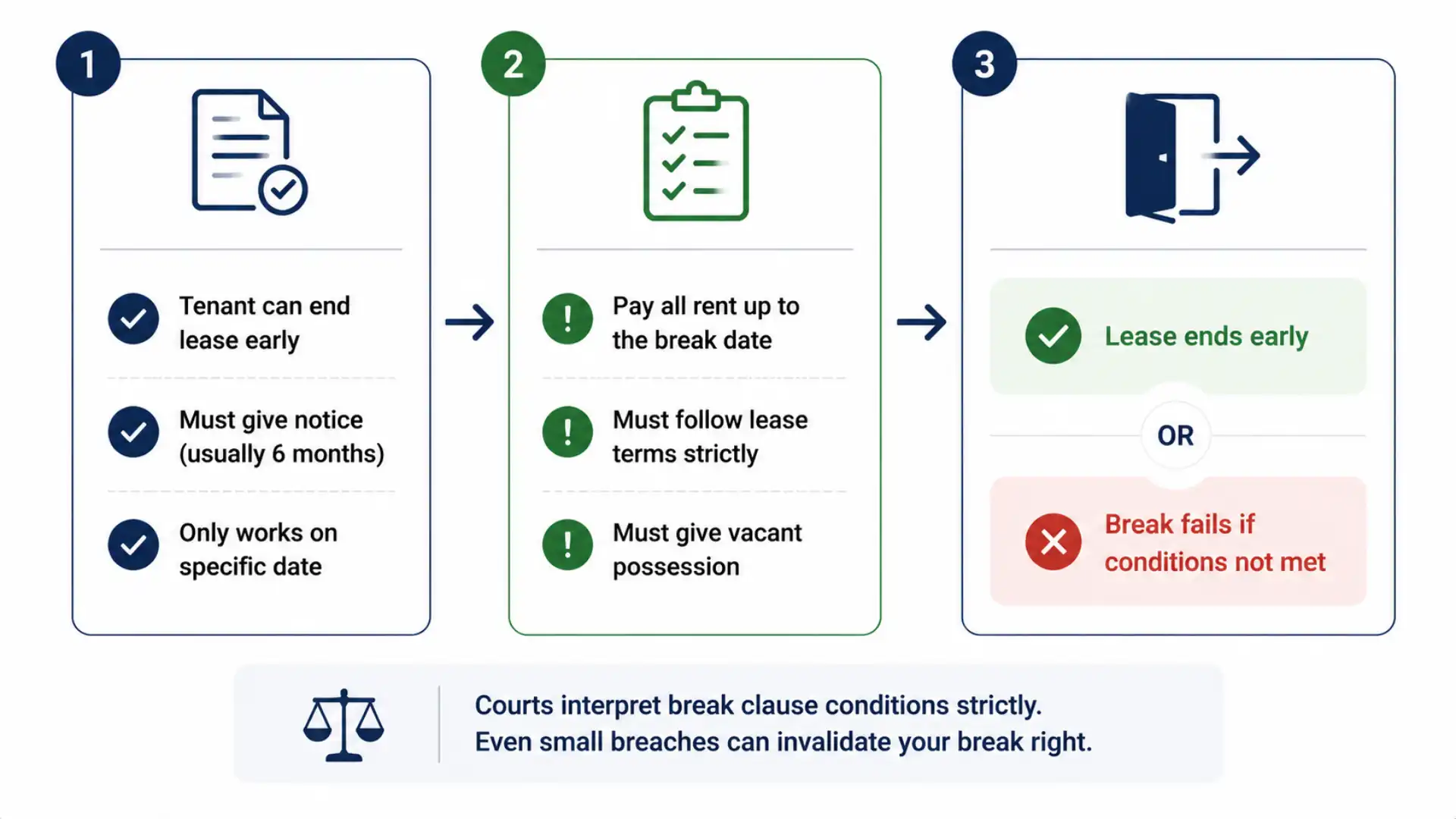
A break clause is one of the most valuable lease clauses a tenant can secure. It gives you the right to end the lease before its contractual expiry — typically on 6 months’ notice — on a specific date during the term. Without one, you are locked in for the full lease period regardless of how your business needs change.
Break clauses are often conditional. The tenant must have complied with all their lease obligations up to the break date. Courts interpret these conditions strictly — even small outstanding rent arrears at the break date can invalidate the exercise. You should push for conditions that are limited to: paying any rent due on the break date, and delivering up the property with vacant possession.
Rolling break rights — which can be exercised at multiple points rather than on a single date — are harder to negotiate but worth pursuing if you are uncertain about your long-term premises requirements. Understanding your full range of tenant rights in commercial lease negotiations here can make a significant difference to the deal you achieve.
Clause 3: Repairing obligations and the schedule of condition
Most commercial leases are let on full repairing and insuring (FRI) terms. Under FRI lease clauses, the tenant is responsible for keeping the whole of the premises in good repair throughout the lease — even if the property was in poor condition when they took it on. This can result in a significant dilapidations claim at the end of the term.
The most important protection a tenant can negotiate here is a schedule of condition — a photographic and written record of the property’s state at the start of the lease. Once agreed and annexed to the lease, this limits the tenant’s repair obligation to keeping the premises in no worse condition than shown in that document.
Without a schedule of condition, your liability on an FRI lease is open-ended. For older or partially refurbished properties, this can represent an enormous financial exposure. This is one of the most critical points in any commercial lease negotiation, and one where professional input pays for itself quickly.
Clause 4: Service charge caps and transparency
For leases of part of a building, a service charge will usually apply. Tenant rights in commercial lease negotiations around service charges are easy to overlook — but service charges can increase substantially over time and in some multi-let developments become a significant cost.
Tenants should push for the following when negotiating service charge provisions:
- A cap on year-on-year service charge increases in the early years of the lease
- A clearly defined list of what the service charge can and cannot include — landlord improvements and capital expenditure should typically be excluded
- The right to inspect quotes, invoices and receipts backing up any charge
- The right to challenge items the tenant disputes
Lease clauses around service charges are sometimes lightly drafted in the landlord’s first version. A solicitor reviewing the lease at heads of terms stage can flag vague or uncapped provisions before they become a problem.
Clause 5: Rent review mechanism
Rent review lease clauses govern how the rent can be changed during the lease term. Historically, upward-only review clauses were standard — meaning rent could only go up at review, never down. From March 2026, upward-only rent reviews are void in new commercial leases in England and Wales, a significant shift in favour of tenants.
Even so, commercial lease negotiation around rent review remains important. Tenants should pay careful attention to:
- The basis on which reviewed rent will be assessed — open market comparables, RPI, fixed uplifts or another mechanism
- The assumptions built into the review (e.g. whether the property is assumed to be let fitted out or in shell condition)
- The process for resolving a dispute if the parties cannot agree the reviewed rent
- Whether time limits and notice provisions could inadvertently trap the tenant into an unfavourable reviewed rent
Unsure which lease clauses carry the most risk for your business?
Commercial lease terms can be complex, and the risks are not always obvious from a first read. If you are entering into a commercial lease negotiation and want to understand what you can push back on, our solicitors can advise on your specific position — speak to the Lease Lawyer team today.
Clause 6: Alienation — assignment and subletting restrictions
Alienation lease clauses govern what happens if your business needs change and you want to transfer the lease to someone else (assignment) or sublet part of the premises. Overly restrictive alienation provisions can leave a tenant trapped — unable to exit a lease that no longer suits their business, even years before a break date arrives.
In any commercial lease negotiation, tenants should insist that:
- The lease expressly states that the landlord cannot unreasonably withhold or delay consent to assignment or subletting
- The grounds on which consent can be refused are clearly defined and limited
- Consent conditions are restricted to reasonable financial tests for the incoming tenant, and rent being up to date
- Any guarantee the outgoing tenant must provide on assignment is limited in scope and duration
Broad, undefined restrictions on alienation can significantly reduce the value of your leasehold interest and your options if you need to exit. Our assignment and subletting advice covers exactly this territory.

Clause 7: Permitted use — keeping your options open
The permitted use clause defines what you can use the premises for. A narrowly drafted clause — such as “retail sale of clothing only” — limits your ability to adapt your business model and makes the lease much harder to assign to a different type of occupier.
In any commercial lease negotiation, tenants should push for a use clause broad enough to cover the range of activities the business could reasonably carry out during the lease term. A use class reference (under the Town and Country Planning Use Classes Order) is often a cleaner approach than a detailed description, as it avoids arguments about whether a minor operational change falls within the permitted description.
Good lease clauses around permitted use also make the property easier to sublet or assign — because a wider use attracts a larger pool of potential incoming tenants, which is in both parties’ interests.
Clause 8: Reinstatement and alterations obligations
Tenant rights in commercial lease negotiations around alterations are frequently underestimated. Most leases prohibit structural changes but permit internal, non-structural alterations with landlord consent. The real risk lies in the reinstatement obligation at the end of the term.
By default, the landlord can require the tenant to remove all alterations made during the lease and return the property to its original configuration. This can be enormously expensive — particularly for fit-outs involving partitioning, specialist flooring or data cabling.
Tenants should try to negotiate lease clauses that either: (a) confirm at the time consent is given that no reinstatement will be required for specific alterations, or (b) include a list of agreed improvements that may remain in place at lease end. This saves money for both parties and avoids disputes at the point of vacating.
Clause 9: Landlord access rights
Landlords routinely reserve rights to enter the property for inspection, repair or to carry out works to other parts of the building. Poorly drafted lease clauses around access can allow the landlord to disrupt your business with minimal notice.
In commercial lease negotiation, tenants should push for access provisions that specifically require:
- Reasonable written notice before any landlord access — typically 48–72 hours except in genuine emergencies
- Access only at reasonable hours aligned to your business operating times
- A duty on the landlord to minimise disruption to the tenant’s business during any works
- Compensation or rent abatement if landlord works cause significant interference with your use and enjoyment of the premises
Access clauses are often treated as boilerplate but should be reviewed carefully. Any broad right for the landlord to enter without restriction represents a real operational risk for tenants. For businesses that hold sensitive client data or equipment, the implications are especially important — and these are just the sorts of issues that can be identified when a solicitor reviews the draft lease. We can flag these through our lease dispute resolution service if problems arise after signing.
Clause 10: Indemnity and liability provisions
Lease indemnity clauses are one of the most overlooked areas of commercial lease negotiation. A broadly drafted indemnity effectively means that if the landlord suffers a loss caused by your breach of the lease, you must pay for it without them needing to prove their losses in court. This shifts significant financial risk onto the tenant.
If a landlord insists on an indemnity clause, tenants should negotiate for it to include a requirement that:
- The landlord takes all reasonable steps to mitigate any loss before calling on the indemnity
- The tenant is given a reasonable opportunity to remedy any breach before the indemnity is triggered
- The indemnity does not cover losses that arise from the landlord’s own negligence or failure to maintain areas under their control
Understanding the full scope of tenant rights in commercial lease indemnity provisions often requires a careful read of how the clause interacts with the wider repair and service charge obligations. These interconnections are easy to miss when reviewing a lease for the first time.
General principles for successful commercial lease negotiation
Beyond these 10 specific lease clauses, there are some wider principles that improve the outcome of any commercial lease negotiation:
- Negotiate at heads of terms stage — it is far cheaper and less adversarial than fighting over a drafted lease
- Research comparable market terms before entering negotiations — knowing what other tenants have achieved recently strengthens your position
- Treat each clause in context — a short lease may justify a more generous repair obligation; a longer lease almost always warrants a break clause
- Do not accept ‘standard’ or ‘our usual form’ as a reason to accept unfavourable terms — in commercial leases, nothing is truly standard
According to guidance from the Royal Institution of Chartered Surveyors (RICS), landlords and tenants should both approach lease negotiations collaboratively, with clarity and transparency about obligations on both sides. This Code for Leasing sets out expectations for how negotiations should be conducted on commercial lettings in England and Wales.
Make every clause work for your business
A well-negotiated commercial lease protects your business for its entire duration. Weak lease clauses — whether around repairs, alienation, service charges or access — create risks that can materialise years down the line, often when the original negotiation context has long been forgotten.
The time to get it right is before you sign. Understanding your tenant rights in commercial lease negotiations, and being willing to push back on terms that do not serve you, is not obstructive — it is simply good commercial practice. Every clause discussed in this article is routinely negotiated in the market. None of them need to be accepted as given.
If you are approaching a commercial lease negotiation and want specialist advice on what to ask for and where there is realistic room to move, our solicitors can guide you through every stage.
Ready to negotiate your commercial lease on better terms?
Whether you are taking a first lease or renewing existing premises, Lease Lawyer provides clear and practical advice on commercial lease negotiation, heads of terms, and all key lease clauses — with a focus on protecting your business throughout the lease term.