
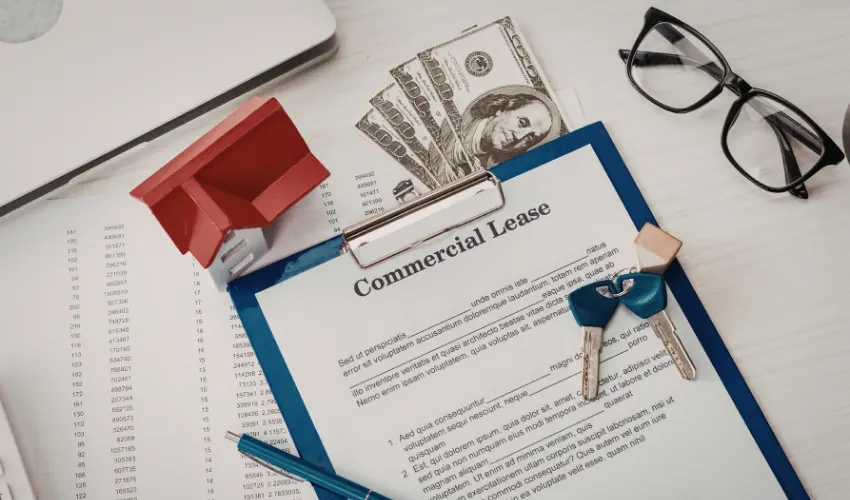
Commercial lease terms can look deceptively straightforward on paper. In practice, each clause carries real financial and legal weight — and signing a commercial lease agreement without fully understanding it is one of the most costly mistakes a business owner can make.
Unlike a residential tenancy, a commercial lease is negotiated between parties on a broadly equal footing. That means the terms you accept at the outset are the terms you live with, often for five, ten, or even fifteen years. Before you sign anything, it is essential to understand what you are committing to. If you are still getting to grips with the fundamentals, our guide to what a commercial lease is and how it works in the UK is a good starting point.
This article breaks down the ten commercial lease terms that matter most — covering everything from lease length and rent reviews to repairing obligations and permitted use. These are the clauses that most often lead to disputes, unexpected costs, and restricted business lease obligations that tenants did not anticipate when they signed. Read each one carefully before you enter any commercial lease agreement.
What is a break clause in a commercial lease?
A commercial lease break clause is a provision within a fixed-term lease that gives one or both parties the right to terminate the agreement before its natural expiry date. Instead of being bound for the full term, the party holding the break right can serve formal notice and bring the lease to an early end — provided every condition attached to that right is satisfied.
Break clauses in commercial leases are most commonly negotiated in favour of the tenant, offering a lifeline if business circumstances change. However, landlord-only and mutual break rights also exist — particularly in leases tied to planned redevelopment or asset disposal.
If you are new to this area, our guide on what a commercial lease is explains the core legal structure in plain English, including how break clauses interact with rent reviews, repair obligations and security of tenure under the Landlord and Tenant Act 1954.
1. Lease length
The lease term is the period during which you are legally bound to occupy and pay rent for the premises. It is one of the most fundamental commercial lease terms to consider, because it defines your financial commitment from day one.
Commercial leases vary considerably in length. A short-term lease of two to three years offers flexibility but provides less security and fewer negotiating rights. A longer term — five to fifteen years — typically secures better rental rates and gives your business a stable base, but it limits your options if circumstances change.
Before agreeing a term in your commercial lease agreement, consider your growth projections, the likelihood of needing to relocate or expand, and whether the landlord is willing to include a break clause to offset the commitment. Length also affects your rights under the Landlord and Tenant Act 1954, which provides statutory renewal rights in many cases — though landlords increasingly seek to contract these out before exchange.
If you are approaching the end of a lease and considering renewal, or need to vary the term as circumstances change, our lease extensions and variations service can help you negotiate and document the changes correctly.
2. Rent and rent reviews
Rent is the most visible cost in any lease, but the rent review mechanism is often where the real financial risk lies. Most commercial leases include provisions allowing the landlord to adjust rent at set intervals — typically every three to five years — and the structure of those reviews can significantly affect your long-term costs.
The most common type is the upward-only rent review, which means rent can increase at review but can never fall, even if market conditions decline. Open-market reviews tie rent to comparable properties in the area. Index-linked reviews use the Retail Price Index or Consumer Price Index as the benchmark.
Understanding the rent review mechanism in your commercial lease agreement is a core business lease obligation — because the rent you agree today is unlikely to be the rent you pay in year five. Tenants who have not modelled the potential impact of upward-only reviews often find themselves significantly overpaying relative to the market by the end of the term. Negotiating for an open-market or index-linked review, or capping increases, can make a substantial difference to your total occupational cost. Our commercial lease terms negotiation service is specifically designed to help tenants challenge and improve these clauses before signing.

3. Break clauses
A break clause is one of the most valuable commercial lease terms a tenant can negotiate. It gives you the right to end the lease early — at a specified point, and subject to conditions — without being liable for the remaining rent throughout the full term.
Break clauses can be tenant-only, landlord-only, or mutual. For most tenants, a tenant-only break is the ideal outcome. The conditions attached to the break are critical: many require that the tenant has complied with all lease obligations at the break date, is up to date with rent, and has given the required notice period — usually six months. Failure to satisfy even one condition can invalidate the break entirely.
This makes break clauses genuinely complex in practice. The notice must be served correctly, the conditions must be met precisely, and any ambiguity in the drafting can be used against you. If a break clause is important to your exit strategy, get the drafting reviewed before you rely on it.
4. Repairing obligations
Repairing obligations are among the most frequently disputed commercial lease terms and among the most financially consequential. The structure of your commercial lease agreement will determine whether you are responsible for the interior only, or for the full fabric of the building.
Most commercial leases are let on a Full Repairing and Insuring (FRI) basis. Under an FRI lease, the tenant bears the cost of maintaining the entire property in good condition throughout the term — including the structure, the roof, and the exterior — and also contributes to the landlord’s building insurance. This applies even if the property was in a poor state when you took occupation.
The critical protection for tenants is a Schedule of Condition — a professionally prepared photographic and written record of the property’s state at the start of the lease. Without one, your business lease obligations may extend to repairing defects that existed before you moved in. At the end of the lease, landlords can serve a dilapidations claim for any disrepair — and these claims can run to tens of thousands of pounds. Repairing disputes are one of the most common reasons commercial tenants seek legal support. Our landlord and tenant disputes team has extensive experience helping tenants challenge excessive dilapidations claims and negotiate fair outcomes.
5. Permitted use
The permitted use clause defines what your business is allowed to do on the premises. It is one of the commercial lease terms that tenants most often overlook — until they try to change or expand their operations and discover they cannot without landlord consent.
The clause will set out a specific use class under the Town and Country Planning (Use Classes) Order, or describe the permitted activity in more precise terms. A lease that permits “retail sale of clothing” does not automatically permit a cafe, a nail bar, or even a different category of retail. If your business model might evolve, or if you are signing on behalf of a business that could be sold to a buyer with different needs, a broadly drafted permitted use clause is significantly more valuable.
Always check that the permitted use in the lease matches both your current plans and your likely future needs. If it does not, negotiate for a wider use before you sign. This falls squarely within the scope of reviewing and negotiating your lease terms — a step that is far easier before exchange than after.
Not sure what your commercial lease terms really mean?
Clauses on rent reviews, repairing obligations and service charges can create unexpected costs for businesses. Speak to a commercial property solicitor before signing a commercial lease agreement so you understand your obligations.
6. Alienation: assignment and subletting
Alienation clauses govern your ability to transfer or share your interest in the property. In practical terms, these commercial lease terms determine what your options are if you need to exit before the term ends, bring in a partner, or sell your business with the lease included. For many tenants, understanding their alienation rights is a core element of managing
business lease obligations responsibly — because without them, you can find yourself locked into a property long after you need to leave.
Assignment transfers the lease to a new tenant entirely. Most leases require landlord consent, and landlords can impose conditions — including an Authorised Guarantee Agreement (AGA) under which you remain liable if the incoming tenant defaults. Subletting allows you to let part or all of the property to another occupier while remaining the head tenant.
Both routes carry obligations and risks that need to be understood before you exercise them. Our specialist assignment and subletting service guides commercial tenants and landlords through the process, ensuring that consents are properly obtained and documentation is correctly prepared.
7. Service charges
If you are taking space in a multi-let building — offices, a retail centre, or an industrial estate — service charges are likely to be a significant additional cost. These commercial lease terms require tenants to contribute towards shared building costs: maintenance of common areas, lifts, car parks, landscaping, security, and building insurance.
Service charges can be unpredictable, and in some commercial lease agreements there is no cap on what the landlord can recover. Review the service charge provisions carefully to understand what is included, who approves expenditure, and whether there is any mechanism to challenge unreasonable costs.
Key questions to ask before signing include: Is there a service charge cap? What categories of expenditure can the landlord recover? Is there a sinking fund for major capital works, and if so, who controls it? Are there audit rights allowing tenants to inspect the accounts? A broadly drafted service charge clause can expose you to costs that were not anticipated at the time of signing.
9. Forfeiture
Forfeiture is the landlord’s right to terminate the commercial lease and recover possession of the property if the tenant breaches a key term. It is one of the commercial lease terms tenants are least likely to think about at the outset — and one of the most important to understand, because the consequences of forfeiture are serious. The business’s right to continue trading from those premises ends immediately.
The most common triggers are non-payment of rent, breach of a repair obligation, or unauthorised use. The lease will set out the procedure the landlord must follow — including any notice period and the opportunity to remedy the breach before forfeiture is enforced. In some cases, a landlord can forfeit simply by changing the locks, which is why tenants in financial difficulty should take legal advice before rent falls overdue.
Tenants who find themselves facing forfeiture proceedings, or who have had a lease terminated and believe the landlord acted improperly, can apply to the court for relief. Our lease dispute resolution team regularly advises tenants and landlords in these situations, helping to resolve disputes before they reach court — and representing clients when they do.
10. Insurance
Insurance obligations in a commercial lease agreement are frequently misunderstood, and failing to comply with them can leave tenants exposed at exactly the wrong moment. In most FRI leases, the landlord insures the building structure and recharges the cost to the tenant as insurance rent. But this covers only the building itself — not your contents, your stock, your equipment, or your liability.
As part of your business lease obligations, you will almost always be required to maintain your own contents insurance, employer’s liability insurance, and public liability cover. Check the lease carefully to see whether specific minimum levels of cover are required, and ensure your policies are renewed on time. If the property is damaged or destroyed during the term, most leases include a rent suspension clause — but its scope and duration vary, so understanding it before an incident occurs is important.
Lorem ipsum dolor sit amet, consectetur adipiscing elit. Ut elit tellus, luctus nec ullamcorper mattis, pulvinar dapibus leo.
Why reviewing commercial lease terms before you sign matters so much
Each of the commercial lease terms above can be negotiated — but only before you sign. Once heads of terms are agreed and the lease is executed, the scope to change unfavourable provisions narrows considerably. A commercial lease agreement is a long-term commitment, and the clauses that seem abstract during negotiation become very real when circumstances change.
The business lease obligations that catch tenants out most often are not the obvious ones — they are the service charge caps that were never negotiated, the break clause conditions that were not met precisely, the repairing obligations that extended further than the tenant realised, and the permitted use clauses that became too narrow as the business evolved. Getting a thorough lease drafting and review before exchange is the most effective way to avoid every one of those outcomes.
The cost of legal advice at this stage is almost always a fraction of the cost of a dispute, a dilapidations claim, or a failed break clause further down the line. The time to understand what you are signing is before you sign it.
Get expert advice on your commercial lease terms today
At Lease Lawyer, we advise business tenants at every stage of the commercial lease process — from first review through to renewal, variation, and dispute resolution. Whether you are entering a commercial lease agreement for the first time or renegotiating an existing one, our specialist team will make sure you understand every term before you commit. Contact our team for a confidential discussion about your lease, or request a fixed-fee quote online to find out exactly what our advice will cost.
Need advice on a commercial lease agreement?
Commercial lease terms define your long-term legal and financial obligations. Our commercial property solicitors review lease agreements, explain key clauses, and help businesses negotiate fair terms before committing to a lease.