
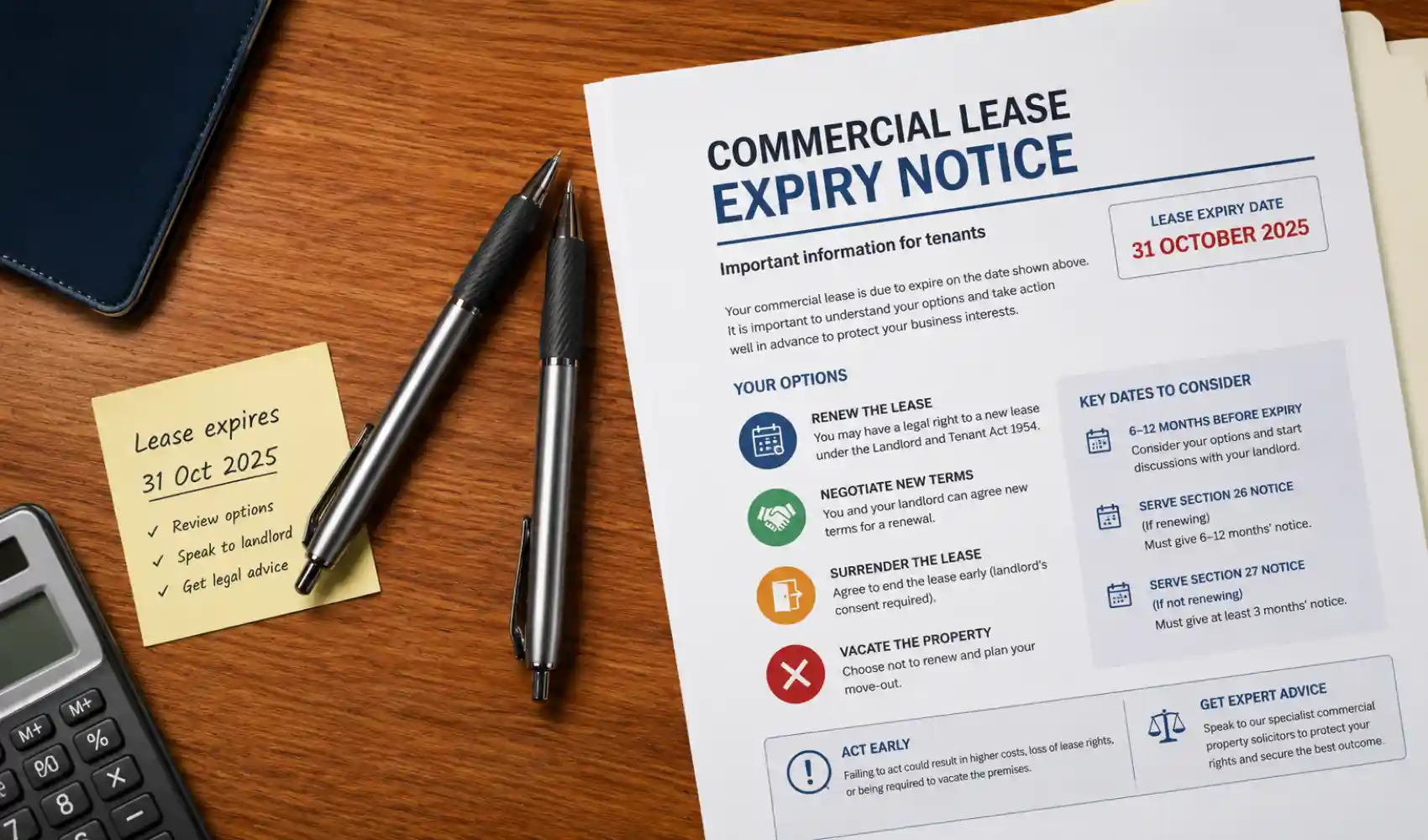
Commercial lease expiry is one of the most significant moments in a business tenant’s journey. Whether your lease term ends in six months or six weeks, understanding your legal position — and acting on it early — can save you from serious financial and operational disruption.
Many tenants assume a lease simply ends on its last day. In practice, that is rarely how it works. Depending on the type of lease you hold and the steps taken (or not taken) by either party, a commercial lease may continue automatically, require formal notice to end, or leave you exposed to liabilities you did not anticipate.
This guide covers the key options available to tenants as a lease approaches its end: renewal rights, holding over, surrendering, and how to protect your position throughout. If you need practical advice tailored to your specific lease, our team at Lease Lawyer is here to help.
Does your lease end automatically? Understanding security of tenure
The starting point at commercial lease expiry is whether your lease is protected by the Landlord and Tenant Act 1954 (LTA 1954). Most commercial leases in England and Wales fall within this legislation unless they were explicitly contracted out of it when they were granted.
If your lease is protected, it does not simply end when the contractual term expires. Instead, the tenancy continues on the same terms until one party takes steps to bring it to a close. This continuation is known as a statutory tenancy, and it sits at the heart of lease renewal rights for business occupiers.
If your lease was contracted out of the LTA 1954, you have no automatic right to remain or renew. The lease ends on its expiry date and you will need to vacate or negotiate a new lease entirely from scratch with your landlord.
Checking this point should be your very first step — ideally well in advance of the lease end date. Your original lease documentation or solicitor will be able to confirm your position.
Lease renewal rights: what the Landlord and Tenant Act 1954 gives you
For tenants with a protected lease, the LTA 1954 provides important lease renewal rights. You have the right to request a new lease on reasonable market terms, and your landlord cannot simply refuse without a legally specified ground.
Section 26 notice — requesting a new lease
If you want to remain in the property and renew, you can serve a Section 26 notice on your landlord. This is a formal request for a new tenancy and simultaneously brings the existing one to an end. The notice must specify the proposed terms of the new lease and give between six and twelve months’ notice.
Once a Section 26 notice is served, both parties can negotiate the terms of the renewal. If no agreement is reached, either party can apply to the court to determine the rent and other terms.
Section 27 notice — giving up the right to renew
If you have decided to leave the property and do not wish to renew, you can serve a Section 27 notice. This ends the tenancy and removes any future entitlement to remain or claim a new lease. It typically requires at least three months’ notice.
A word of caution: once served, a Section 27 notice generally cannot be withdrawn. Do not serve one unless you are certain you want to vacate, as it extinguishes your lease renewal rights entirely.
Landlord opposition to renewal
A landlord can oppose a lease renewal on specific statutory grounds, including plans to redevelop the property, persistent rent arrears, or a desire to occupy the premises themselves. If the landlord successfully opposes your renewal on certain grounds, you may be entitled to compensation.
Our lease extensions and variations service can help you understand whether your renewal request is likely to succeed and how best to negotiate the terms of a new lease.

Holding over: what happens if no notice is served
Holding over a commercial lease is what happens when a tenant continues to occupy the property after the contractual term has ended, without either party serving a formal notice. If your lease is protected by the LTA 1954, this is generally permissible — you continue on the same terms as the original lease, including the same rent.
Many tenants hold over deliberately while negotiations for a new lease are ongoing. Others do so unintentionally, simply because neither party has acted. Either way, holding over a commercial lease means you remain legally bound by the full obligations of the original lease — including rent, repair, and compliance duties.
There are risks on both sides. As a tenant holding over, you have no certainty about how long you can remain. Your landlord can serve a Section 25 notice at any point to bring the statutory tenancy to an end and either offer new terms or oppose renewal. As a landlord, a tenant holding over means ongoing liability uncertainty and potential complications if you have plans for the property.
It is rarely advisable to let a commercial lease expiry pass without taking legal advice. Even if you want to stay, drifting into a holding over position without a clear strategy leaves your business exposed.
Not sure whether your lease gives you the right to renew?
Lease renewal rights under the LTA 1954 can be complex, and the steps you need to take depend heavily on your specific lease and circumstances. If your commercial lease expiry is approaching and you are not sure whether you are protected or what notice you need to serve, speaking to a specialist lease solicitor at this stage can prevent costly mistakes and protect your position.
Vacating at the end of the lease: what tenants must do
If you have decided not to renew and intend to leave at commercial lease expiry, your obligations do not end the moment you hand back the keys. Most leases impose strict conditions on how the property must be returned, and failing to comply can result in significant financial claims against you.
Dilapidations
Dilapidations refer to the condition in which you are obliged to return the property under the terms of your lease. Most commercial leases require tenants to return the premises in full repair and to reinstate any alterations made during the tenancy.
Your landlord is likely to carry out a dilapidations inspection either shortly before or after the lease end. If the property falls short of the required standard, you may face a claim for the cost of the necessary works — sometimes a substantial sum. It is sensible to commission your own independent schedule well in advance so you understand the likely exposure and can take steps to address it.
Disputes over dilapidations are common and can be contentious. Our dispute resolution team advises tenants on challenging unreasonable dilapidations claims and negotiating settlements.
Giving vacant possession
Vacant possession means the property must be completely empty and free from any occupation or encumbrance when you leave. This means removing all equipment, stock, and personal property — down to the last item. Courts have found tenants to be in breach simply because minor items were left behind, which can have significant consequences at commercial lease expiry.
If you fail to give proper vacant possession and your lease contains a break clause or notice provision that depended on it, the notice may be invalid and the lease could continue against your wishes.
Alternatives to vacating: assignment and subletting
If you do not want to renew but also cannot afford the remaining lease term, there are options other than simply waiting for commercial lease expiry. Two of the most common are assignment and subletting.
Assignment means transferring the whole of your lease to a new tenant. The incoming tenant takes over your obligations for the remainder of the term. Most leases permit assignment subject to your landlord’s consent, which cannot be unreasonably withheld. You may be required to guarantee the incoming tenant’s obligations as a condition of consent.
Subletting involves granting a sub-lease to a third party for part or all of the premises. You remain the tenant under your original lease and continue to be liable for rent and obligations to the landlord, but the subtenant pays you rent which offsets your costs.
Both routes involve legal complexity, especially regarding landlord consent and the drafting of new agreements. Our team advises on landlord and tenant disputes and consent issues to help tenants navigate these arrangements properly.
It is also worth being aware of the law on assignment in the context of the LTA 1954. If your business needs change, the government guidance on commercial lease obligations provides a useful overview of your broader obligations as an occupier.
How far in advance should you be planning for commercial lease expiry?
The honest answer is: much earlier than most tenants think. Ideally, you should begin considering your options at least 12 months before the lease end date — and earlier still if you hold a lease protected by the LTA 1954, since notice periods and court processes can take considerable time.
Here is a rough timeline to keep in mind:
- 12+ months before expiry: Review your lease in full. Confirm whether it is LTA 1954 protected. Identify your notice obligations and deadlines. Consider whether you want to renew, assign, sublet, or vacate.
- 6–12 months before expiry: Begin negotiations with your landlord if you want to renew or agree different terms. Commission a dilapidations survey if you plan to leave. Take legal advice on notices you may need to serve.
- 3–6 months before expiry: Serve the relevant formal notices. Finalise plans for the property. Ensure your team understands their obligations around vacating, repair, and returning keys.
- At expiry: Give proper vacant possession. Confirm all obligations under the lease have been met. Retain records of the handover process.
Missing key deadlines in this timeline — particularly around formal notices under the LTA 1954 — can have serious consequences, including losing your lease renewal rights or remaining liable for a property you have vacated.
Common mistakes to avoid at the end of a commercial lease
Commercial lease expiry is an area where even experienced business occupiers make costly errors. Here are some of the most common pitfalls:
- Not checking whether the lease is LTA 1954 protected. This fundamentally affects your rights and obligations.
- Serving notices too late or incorrectly. Notices under the LTA 1954 must comply with strict requirements as to timing, form, and method of service.
- Assuming the lease ends automatically. For protected leases, this is not the case — the tenancy continues until someone acts.
- Handing back the keys without formal documentation. Without written confirmation from your landlord, this does not necessarily end the lease.
- Ignoring the dilapidations position until it is too late. Addressing repairs early is almost always cheaper than dealing with a claim after you have vacated.
Ready to get clarity on your commercial lease expiry?
Whether you are approaching a lease end date, considering your renewal options, or concerned about dilapidations and holding over obligations, taking early advice makes a real difference. The decisions you make in the months leading up to commercial lease expiry can protect your business from significant financial and legal exposure. At Lease Lawyer, we work with business tenants and landlords across England and Wales to navigate lease end arrangements clearly and confidently. Get in touch today.